
History makes it clear that invasions, terror attacks and other geopolitical shocks don’t generally do that much damage to asset prices and, therefore, to market levels.
— RECOMMENDED —
 GOLD ALERT: Extraordinary Upside in ONE Stock (Not a Miner)
Gold prices just surged to the highest level in a year and could be on the verge of the biggest bull run in half a century. (It gained 1,700% during the high-inflation 1970s.) Now, a top analyst says you can capture ALL of the upside without touching a risky miner or a boring exchange-traded fund. He sees 1,500% potential gains long term with very little risk.
The Shocking Truth About Stocks During Wartime
Matt Benjamin, Senior Markets Expert, The Oxford Club
My friend was shocked.
She couldn’t believe that the stock market could rise, as it did on Thursday and Friday of last week, amid the carnage and horror that the people of Ukraine are currently enduring.
I tried – gently – to explain to her that she had it all wrong. The stock market is not a gauge of happiness or contentment with current events. Nor is it a judgment about whether the state of the world is improving or regressing.
It is, simply, a measure of what investors collectively believe the price of assets will be sometime in the near future, perhaps six to 12 months from now.
Of course, despite the nearly 4% rise in the S&P 500 Index late last week, the market has been in a correction since early January. That downturn preceded – and I would argue it was largely unrelated to – the Russian aggression in Ukraine.
Indeed, we saw a correction of almost 12% in the S&P 500 from January 3 to February 23. The Nasdaq Composite has fared even worse, with a drawdown of almost 19% from mid-November to February 23.
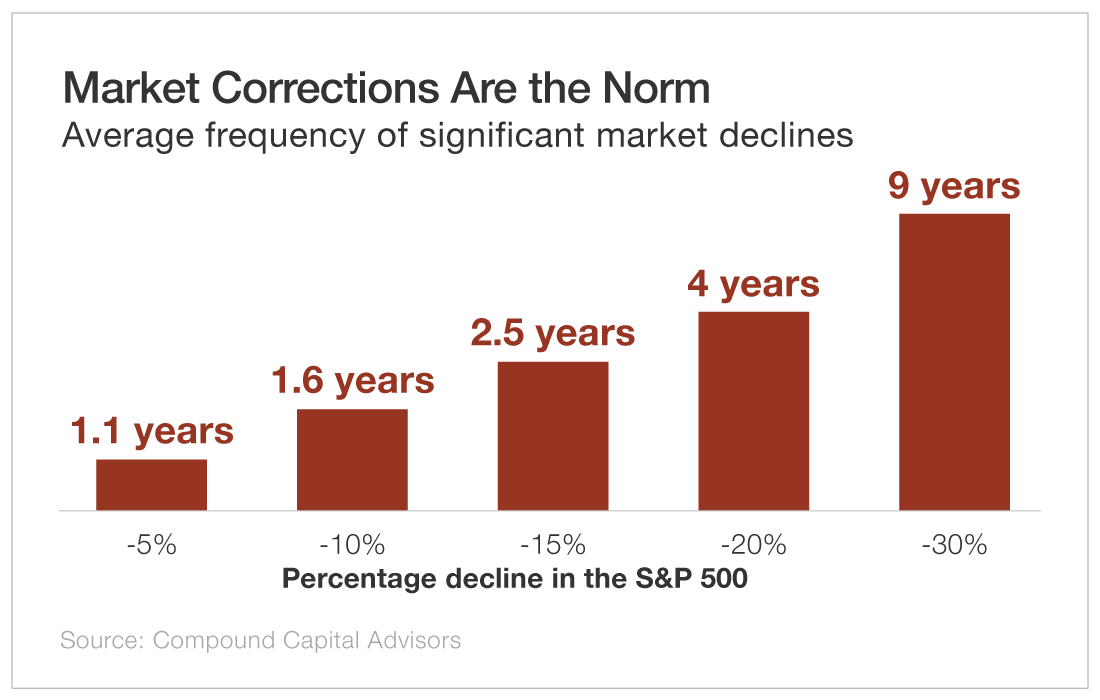
Yet, this broad market correction is perfectly normal. In fact, it was overdue.
On average, the market experiences a correction of 10% or more every 18 months or so. And last year we didn’t have one at all. The last correction in the S&P 500 was in March 2020, nearly two years ago.
Markets and War
The recent market drawdown, before the Russia-Ukraine situation took center stage, did have some direct causes, however.
One was the stretched valuations of stocks. The Shiller price-to-earnings ratio for the S&P 500 rose to nearly 39 late last year, a level reached only once before, on the cusp of the 2000 dot-com bust.
The other cause was the recent pivot by the Federal Reserve, which, after years of easy monetary policy, suddenly turned hawkish and signaled plans for multiple rate hikes in 2022.
A 10% correction is an utterly natural market reaction to those two factors.
And then, of course, geopolitics intervened, as it often does. Russia began the ramp-up to its Ukraine invasion, making markets even more jittery. The CBOE Volatility Index (VIX) has been rising steadily since February 9 and is now near its highest level in a year.
But interestingly, history makes it clear that invasions, terror attacks and other geopolitical shocks don’t generally do that much damage to asset prices and, therefore, to market levels.
Since the Japanese attack on Pearl Harbor on December 7, 1941, the average market drawdown from geopolitical shocks has been just 5%. And the market bottomed, on average, 22 days later and recovered within 47 days.
In another example, the 9/11 terrorist attacks on the U.S. sent the S&P 500 down 4.9% in one day and 11.6% overall. But the market bottomed just 11 days later and recovered in one month.
A war can even produce a bull market. The Dow Jones Industrial Average rose 50% from the beginning of World War II in 1939 until the end of the war in late 1945, according to research by money manager Ben Carlson. That’s a gain of more than 7% a year.
Will this market react to the Russian invasion of Ukraine in a similar way? Of course, it’s impossible to know.
But as Chief Investment Strategist Alexander Green said, “Corrections and bear markets are great opportunities to accumulate positions in companies that are likely to outperform when the market bounces back.”
When the market does resume its relentless climb higher – as it always does – microcap stocks may be poised to gain the most.
More than 85 years of data support the case that microcap stocks have been by far the highest-returning segment of the domestic equity market. If you want to know what microcaps Alex likes the most, click here.
— RECOMMENDED —
This Top-Performing Class Of Stocks Is Set To Produce Astounding Gains in 2022

There’s a profit-packed set of stocks that Wall Street typically can’t invest in, but you can.
Alexander Green has found a way to beat the odds – providing the average investor with the chance to start targeting some of the market’s largest moves.