The fabric of our society has been forever changed by one simple mistake…
Over the past 15 years, the folks who made this error have never admitted wrongdoing… And they have continued to miss the dozens of opportunities to fix it.
Their failure has devastating repercussions for millions of people.
History suggests the consequences will be with us for decades to come. And they will have drastic, permanent political and social consequences.
The human error we’re referring to is a simple one…
From December 2008 to March 2022, the world’s biggest central banks mostly kept interest rates at their lowest levels ever… And they were at zero roughly two-thirds of the time.
That led to massive valuation distortions across the nation… as well as super-risky investments in stocks, bonds, real estate, and more.
But the worst is yet to come…
Since March 2022, the Federal Reserve has hiked rates at a faster pace than any previous hiking cycle since 1980. And today feels eerily like 2008…
- In the past year and a half, we’ve seen three of the largest bank collapses in history.
- Consumers are in the worst financial shape they’ve been in since 2008.
- Credit-card debt is at the highest level in history.
This will not end well for investors who aren’t prepared.
[optin-monster-inline slug=”zwsrujfgy8wfokbjteps”]
What to Expect in 2024?
The stock market is supposed to be riskier than the bond market.
Bonds are supposed to be for your “safe money.” Stocks are where you’re supposed to go if you want to take a little more risk in exchange for a little more return.
But the two markets are now priced opposite of what you’d expect.
The bond market keeps falling. It’s pricing in more and more risk. And the stock market keeps trading at mega-bubble valuations.
In other words, investors are pricing stocks like they don’t have a care in the world. And bonds are trying to wake them up to growing risks… like inflation and the conflicts in Ukraine and Israel.
The bond bear market is still in full swing, with 10-year Treasury yields recently hitting their highest levels since 2007. Investors who count on bonds to keep them afloat when stocks weaken are really taking it on the chin these days…
In fact, the traditional 60/40 portfolio logged its worst performance in 2022 since the 1930s… And it had a rough ride again in 2023.
The 60/40 portfolio is a simple idea…
It means you have 60% of your money in stocks and 40% in bonds. When the stock market isn’t doing so well, the bonds tend to pick up the slack. That makes it easier to hang on to your stocks for the long term.
But today, everything is different.
In short, many folks seem to think the next 40 years will look like the past 40 years. They don’t understand what an unusually easy time they’ve had in the markets since about 1980.
You can no longer mindlessly buy every dip in the stock and bond markets. You also can’t expect to make double-digit returns every year for the next four decades.
Those days are over.
Don’t be fooled by the calm in the markets today.
The worst economic storm since 2008 is coming, and soon.
To see how the next great economic calamity is already playing out, please read this report carefully. It details specific opportunities and ways that you can prepare for more volatility through 2024… protect your portfolio… and even profit from the coming crisis.
By the Stansberry Research Editorial Staff
Source: StansberryResearch.com
Top Five Stocks to Buy 2024
Opportunity #1: Hershey (HSY)
It’s no longer surging at multidecade highs. But inflation remains in the headlines today…
And those high prices aren’t going down anytime soon.
Inflation is a major fear for anyone who saves and generates income for their nest egg. For example, if you’re saving for retirement and you’ve planned to earn a certain amount per year from investments, inflation means that same amount is now worth less.
Even small increases in inflation add up. And the expectations for inflation will drive investment returns. When you expect inflation, you position yourself differently than you would if you expect deflation. And other investors doing the same thing will drive some investments to lead and others to lag.
So, what do you want to own during periods of higher inflation?
Own stocks of good companies that have pricing power.
That means if inflation strikes, you want to own a good business that can raise prices. Not all of them can. But businesses with in-demand products and happy customers can charge a bit more to pass on rising costs like wages or materials.
And Hershey (NYSE: HSY) fits that bill perfectly.
Hershey is the largest chocolate confection maker in the United States. The company makes the iconic chocolate “kisses.” And it sells sweets under about 100 other brands, including Reese’s, Twizzlers, Milk Duds, Jolly Rancher, and Whoppers.
While mostly based in the U.S., the company also has operations in 80 countries around the world. But very little about the business has changed in more than 100 years.
Hershey sells food products that people buy in good times and bad. That makes it relatively resistant to economic downturns.
Hershey is also one of the most capital-efficient businesses in the world. The beauty of running a capital-efficient business: As sales and profits grow, capital investments don’t. Thus the amount of money that’s available to return to shareholders grows in both nominal dollars and as a percentage of sales.
Hershey loves to reward shareholders through dividends and buybacks. With a solid and predictable profit growth, the company’s brands and products are resilient and should stand the test of time.
Action to take: Add Hershey (NYSE: HSY) and other capital-efficient businesses to your portfolio in 2024.
If you’re over the age of 50 and your retirement plans depend on your portfolio recovering in the next few years…
Then one man has an urgent message you need to hear.
He says the losses we’ve seen since the market peaked are just the beginning.
What we’re going to experience over the next few years could be worse than the Great Depression, the dot-com bust, and the global financial crisis combined.
What happens to your retirement if the destruction you’ve seen in financial markets so far is just the tip of the iceberg?
Can you withstand another 50% drop in asset values from here… or a market that goes nowhere for potentially decades?
The mother of all crises has been brewing for more than 20 years.
There are still more huge losses coming. Economists know it. Most of the senior leaders in Washington, D.C. know it, too.
We are in a moment of extreme danger, on the brink of financial collapse. And for millions of Americans, their finances and retirements hang in the balance in a big, immediate way. Learn why by clicking here.
Opportunity #2: CBOE Global Markets (CBOE)
CBOE Global Markets (CBOE) operates the largest options exchange in the world, as well as equity and foreign-exchange markets in the U.S. and Europe.
It opened its doors 50 years ago as the first exchange to list standardized equity options contracts. And today, about 60% of CBOE’s revenues are still from options trading.
Retail trading in both stocks and options has soared in recent years…
And this explosion in retail-trading activity is a boon for CBOE. It doesn’t matter whether these traders are making a profit… CBOE scrapes a little off the top on each and every trade that goes through it.
By matching a buyer to a seller on one of its exchanges, CBOE receives a transaction fee from the broker. These types of fees make up CBOE’s “transactional revenue”. Increased volume and volatility mean more transactional revenue for CBOE.
Even more important, the CBOE doesn’t require big capital expenditures to maintain and expand its business. That means it can richly reward shareholders with its free cash flow…
In addition, CBOE has also built and experimented with two widely known proprietary options products, those for the S&P 500 Index and its proprietary Volatility Index (“VIX”). The VIX, which launched in 1993, is undoubtedly the best-known CBOE product…
It measures future expectations of volatility… the implied volatility of the S&P 500 over the coming 30 days. It has essentially become the market’s “fear gauge.”
The VIX is the only product of its kind – nobody has a viable competitor. So in a way, this gives CBOE a monopoly on fear in the market.
The higher the VIX, the higher the expected volatility. And since volatile markets and high trading volume often go hand in hand, the CBOE tends to profit from those market conditions through its wide variety of products…
So no matter what you expect to happen in 2024, you should take a closer look at the company…
CBOE has been outperforming the market through 2023. And “smart money” institutional buyers have taken a strong interest in this company.
Action to Take: CBOE Global Markets (CBOE) is a buy with its “Very Bullish” rating from the Chaikin Power Gauge.
Power Gauge founder and Wall Street legend Marc Chaikin has been one of the most influential contributors to financial strategy and technology in the past 50 years of stock market history.
He is best known as the creator of one of Wall Street’s most popular indicators… a system now seen in every Bloomberg and Reuters terminal in the world. It’s used by hundreds of banks, hedge funds, and every major brokerage site.
The software Marc designed and built to predict the future behavior of stocks accurately predicted nearly every twist and turn in U.S. stocks last year.
In his 50-plus years on Wall Street, he has followed a lot of “hot” trends and sectors…
But he has never seen anything like what’s happening in the AI market right now.
He recently applied his technology to the A.I. market, and what he found was incredible.
And there was one clear winner. It’s an overlooked A.I. company trading for a fraction of the price of Nvidia (NVDA)… But it already has lucrative partnerships with big players like Microsoft (MSFT).
This could be the best AI stock to buy in 2024.
That is why he decided to name it – ticker symbol and all – in a recent interview with financial researcher Kelly Brown. You can get all the details right here.
Opportunity #3: America’s TOP Retirement Stock
The Vietnam War is often referred to as the “Helicopter War”…
Since Vietnam lacked a sufficient network of roads, its jungles and mountains were difficult to access. Helicopters helped move troops, provided air support, handled medical evacuations, and performed search-and-rescue missions.
In total, roughly 12,000 helicopters served in Vietnam. Nearly half of them were shot down. American helicopter pilots and other crew members accounted for nearly 10% of all U.S. casualties in the war – and many times that number were wounded.
The helicopter used in the Vietnam War was the UH-1 Iroquois helicopter, better known as the “Huey.”
Folks who flew the Huey swear by and adore it. But the numbers from the Vietnam War don’t lie. These choppers didn’t have a long lifespan.
After Vietnam, the U.S. Army replaced the Huey with the superior UH-60 Black Hawk. It was bigger, faster, and more powerful.
Ever since its adoption in June 1979, the Black Hawk has been the workhorse for the U.S. military. American forces have relied on it in just about every major conflict over the past few decades.
Helicopters are essential tools in modern warfare… And they will be for the foreseeable future as global tensions continue to rise.
And helicopters are just one small portion of the U.S.’s massive defense budget.
Let’s be clear… No one is rooting for war. The carnage is horrific. It destroys countries and displaces millions from their homes. We’d far prefer the world hurtling toward an idyllic future where our common humanity is universally respected.
But that doesn’t seem like the way things are going.
So instead, we need to be clear-eyed investors and put our money to work where capital is flowing. In a world like ours, it’s going to flow into the defense industry.
And recently, a former Goldman Sachs trader released a full presentation detailing a secretive company… a major player in the defense industry. It’s so powerful that he calls it his No. 1 retirement stock.
- It has TWICE the returns of Tesla (TSLA)… handing early investors more than 18,000% gains in the past decade.
- It’s LESS VOLATILE than Warren Buffett’s Berkshire Hathaway (BRK.B).
- And it even pays a dividend that’s FIVE TIMES larger than Apple (AAPL).
This ex-Goldman Sachs banker has waved goodbye to Wall Street.
Instead, he has put together an extensive, exclusive report for you – along with a video so you can follow along with every chart.)
As he puts it: “If I had to pour every penny of my retirement into just one stock, this stock would be it.”
After what feels like nearly a decade of disappointing performance, we believe gold is on the cusp of a major bull market.
The conditions are in place for a historic move.
Between increased market volatility, economic and political pressures, inflation, and personal debt in the U.S. reaching more than $30 trillion… the evidence is overwhelming for this historic shift in the gold markets.
Investors have been flocking to gold for its integral role as a hedge against inflation and market chaos.
Some of the world’s smartest investors are jumping in, too.
David Einhorn, founder of Greenlight Capital, owns a gold position worth $40 million.
Billionaire bond king Jeffrey Gundlach told Yahoo Finance:
“Gold is going to go a lot higher.”
Egyptian billionaire Naguib Sawiris says a QUARTER of your portfolio should be in gold as inflation remains high…
Legendary hedge-fund manager John Paulson says you’re better off owning gold than dollars, and has invested more than $200 million into this space.
But it doesn’t stop there…
Billionaire hedge-fund founder Ray Dalio told readers not long ago he sees a paradigm shift happening in the gold market. He compared today’s price movements with historical turning points like:
- Gold’s historic 2,300% leap in the 1970s from $35 to $850 per ounce after President Richard Nixon took the U.S. off the gold standard…
- And in the early 2000s, when gold tripled in value – soaring from less than $300 per ounce in 2000 to $1,000 by 2008.
Today, many of the most powerful, well-connected, and smartest investors in the world are loading up on gold in unprecedented ways.
And today, there’s an easy one-click way to get exposure to gold in your own portfolio…
Action to take: Buy SPDR Gold Shares (NYSE: GLD). It provides nearly direct exposure to the price of gold. It owns more than 20 million ounces of gold in secured bullion. GLD is a fine way to get exposure to the gold trend.
This may well end up as the greatest precious metals bull market of the past 100 years. The evidence is everywhere…
- Market volatility is rising.
- Inflation recently hit its highest level in 40 years. And it remains far more elevated for Main Street Americans than most folks in Washington D.C. will admit.
- Economic and political pressures are reaching a boiling point.
Not to mention, nearly every country is devaluing their currencies, one by one, with money-printing… engaging in what looks like a disastrous race to the bottom.
And there’s one precious metals investment that may be one of the world’s most profitable and low-risk investments – yet it’s still virtually unknown.
Anyone can use it. It’s as simple as buying a stock in your ordinary brokerage account.
So if you plan to buy gold today, you owe it to yourself to find out more about this small stock. It’s not a mining stock, exchange-traded fund, or bullion – but this virtually unknown investment could hand you a small fortune as gold soars higher. Learn more by clicking here.
Opportunity #5: Ciena (CIEN)
It’s hard to fathom how much data is ripping through global networks…
The amount of data created each year is growing at a compound annual growth rate of about 26%. By 2025, the amount of data transmitted through global networks is expected to reach 175 zettabytes, about a 10-fold increase from a decade ago.
As more and more data floods global networks, it has to also flow faster than ever…
The only way to do that is to broaden the “pipes” and expand network bandwidth.
And today, U.S. network providers can no longer source the equipment they need from “high risk” Chinese telecom companies like Huawei and ZTE. It’s a matter of national security, and against the law.
Instead, they’re turning en masse to U.S.-based networking equipment providers, particularly Ciena (NYSE: CIEN).
Ciena provides hardware and software products and services that support communications networks around the world.
For the past 30 years, Ciena has focused on network innovation to improve connections between businesses and users. So it understands firsthand the growing importance of expanding bandwidth, and it has pioneered the technology to do exactly that…
Traditionally, telecom companies add fiber-optic cables to increase network bandwidth. These cables are the workhorses of international networks.
As the digital economy has grown over the past two decades, so too has the global presence of fiber-optic cables. In the oceans alone, cables stretch 750,000 miles in nearly every direction, leading to and from every continent, subcontinent, and inhabited island…
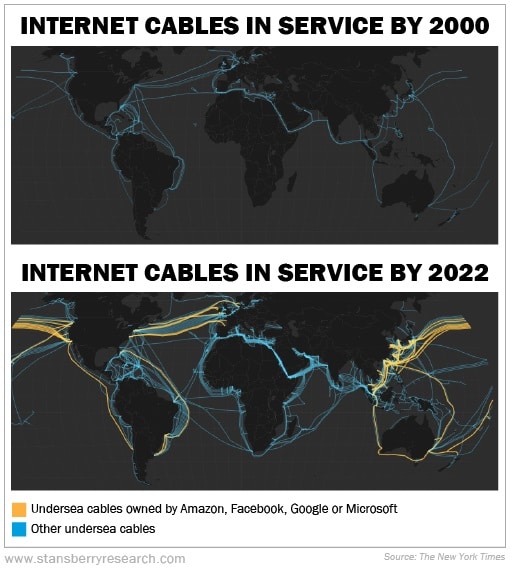
Continuing to lay more fiber-optic cables is the most common way to expand bandwidth.
And Ciena offers an alternative, more innovative solution: increasing the amount of data each existing fiber can carry.
This doesn’t require any new cables. And it goes beyond quickly pushing data from one end of a fiber to the other, although that’s a big part of network evolution…
Ciena’s solution involves a technology called dense wavelength-division multiplexing (“DWDM”). It helps to increase the bandwidth of fiber-optic networks.
It’s sounds complicated. But there’s an easy way to visualize it…
Imagine you’re standing at the end of a dark hallway. Someone at the other end is sending you coded messages with a flashlight. Think about how much more information you could send down that hallway if you had three more people all sending information at the same time. To avoid confusion about which person is sending what signals, you could give them all a different colored flashlight.
DWDM technology functions in a similar way. Here’s a simple diagram to illustrate the mechanism…
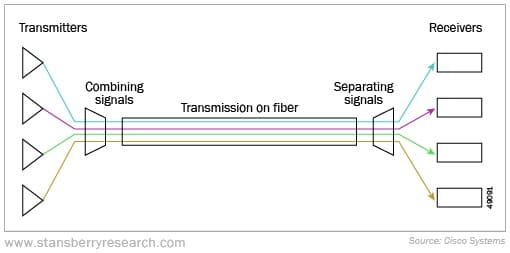
Without the scalability and reach of DWDM systems, most of today’s Web 2.0 and cloud-computing solutions would not exist. (Web 2.0 refers to websites that emphasize user-generated content and ease of use.)
Today, Ciena supports more than 85% of the world’s largest network providers, including Verizon, AT&T, Alphabet’s Google, Amazon, and T-Mobile.
And it continues to pour money into research and development, successfully improving on its early technology with an alternative approach, using “coherent light.”
For example, Ciena’s newest DWDM equipment is called WaveLogic. It can accommodate up to 80 channels over a single fiber – a capacity boost of 400% from the prior technology.
With the growing need to increase network bandwidth, Ciena is in a great position.
Action to take: Ciena (NYSE: CIEN) shares are a strong buy in 2024.
And there’s one more massive technological development coming soon…
It will likely arrive at your mailbox in a letter from the “Bureau of the Fiscal Service.”
That’s the branch of the U.S. Department of Treasury that pays out Social Security benefits… issues tax refunds… and paid out stimulus checks during the pandemic.
And right now, it’s rolling out a radical new technology that could have a big impact on your bank account and retirement income.
This technology has the full backing of the White House and Federal Reserve.
And 41 banks, including JPMorgan Chase… Wells Fargo… and BNY Mellon, are already rolling it out.
If yours isn’t one of them, it likely soon will be.
That means you only have a short window of time to prepare for these changes.
Wired magazine says the rollout of this technology could “shake the US financial system.”
These sudden changes could leave many people in the dark, but you don’t have to be one of them.
Here are three moves to make immediately… before your bank adopts this new technology.