You’ve seen the headlines.
California’s water crisis is dangerous, just like Flint’s.
U.S. faces ‘nationwide drinking water crisis.”
The global fight for water is getting ugly.
That was just the tip of the iceberg in May 2017.
At the time, reports surfaced that more than 77 million Americans were just exposed to unsafe drinking water, many of which were exposed to excessive levels of copper and lead. In fact, according to study, titled, “Threats on Tap,” there were water violations in all 50 states in 2015.
And two, at the time, the global community was in crisis with no solution.
Globally, stores full of underground water – which collects in aquifers — were disappearing at an incredibly alarming rate. In fact, according to a study from Nature, the most severe depletion had been found in areas that have relied significantly on aquifers to grow crops, mainly the U.S., Mexico, the Middle East and North Africa, India, Pakistan and China.
“This depletion of the largest liquid freshwater stock on Earth,” they wrote, “threatens the sustainability of food production, and water and food security, not only locally, but also globally via international food trade.
Experts Warn About Upcoming Stock Market Crash. Are You Protected?
Learn How Investing in Gold ETFs Can Yield Consistent Monthly Returns
Regardless of Which Way the Market Is Moving
Click Here to Register for this Free Webinar
Granted, nearly 75% of the world’s planet may be covered in water, but only 3% is fresh water needed for drinking, bathing, and food preparation. Unfortunately, of that 3%, only 1% is accessible or safe for consumption.
Yet, the global community is exploding in size, meaning that demand is far outweighing supply. The United Nations reports that one in nine people have no access to clean water. Even more will face water stress by 2025, as the world’s population rises.
By 2050, another two billion more will need fresh water for drinking, say experts. But there won’t be enough to go around if we don’t find a solution now. It’s why companies are scrounging to help teach purification, conservation and water replenishment tools in areas under the most stress. Other companies are seeking technological solutions, as well.
In short, we’re in a race for clean water technology that can solve the problem now.
Without a solution things will only get worse.
But of all the solutions, of all the stocks, some of the best opportunities were in water related ETFs. They’re some of the best, and most cost-effective investing tools that give you proper diversification with a variety of related stocks. As we’ve often explained, investing in an ETF is often a better choice than a mutual fund or paying too much for an individual stock.
If we take a look at some of the hottest water ETFs at the time, including:
- First Trust ISE Water Index Fund (FIW)
- The Guggenheim S&P Global Water Index ETF (CGW)
- The iShares Global Water Index ETF (CWW.T)
- The Power Shares Water Resources Portfolio (PHO)
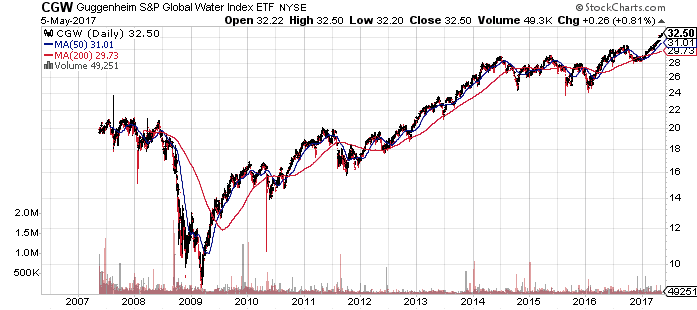
We can clearly see we’re not the only ones that saw the opportunity.
As for being cost effective, look at the FIW ETF. It currently trades at $42 a share. One of its holdings is a water company called Xylem (XYL), of which FIW holds a 3.92% stake, as of May 2017. XYL by the way traded at $52 at the same time.
Ask yourself this.
Would you rather pay $52 to hold one water stock like XYL, or would you rather pay $42 to hold dozens of water related stocks giving you broad exposure?
The best part – in May 2017, water was quickly emerging as one of the most investable natural resources on the planet. It was a classic tale of scarcity and falling supplies met with incredible global demand. Despite the fact that water covers much of our planet’s surface, only 3% of it is considered fresh. Less than 0.1% is safe for human consumption.
As the supply-demand story heated up, so did the interest in exposure to smart water trades, like those found with ETFs.