
On Wednesday, May 26th at 8 pm, tech expert Jeff Brown is holding an emergency meeting #2 to reveal what may be the most controversial recommendation of his career…
Jeff calls it a “once-in-a-lifetime shift”…
This is an unprecedented and rapidly developing situation…
And Jeff believes over the next 12–24 months, a trillion dollars could be at stake…
— RECOMMENDED —
Tech Expert: “S.A.V. Will Be Huge”

S.A.V. – that’s Elon Musk’s next big project that will shock the world.
And after months of research, this tech expert finally found the company that’s behind this new project.
This is all part of a $30 trillion trend that’s set to dominate this decade.
But hurry – all the big players are already getting in.
For example, Warren Buffett has already invested $15 billion in this trend… and said he’s ready to invest $15 billion more.
There’s no time to waste… click here now and get all the details
Jeff Brown’s Emergency Meeting #2: The Best Shot at Amazon-Like Gains Right Now
There’s a new investment trend that’s taking the hottest early-stage companies public… and allowing regular investors to invest before they access the markets.
When a promising early-stage company goes public, it can create historic opportunities for early investors to collect outsized gains.
Take Amazon, for example…
Back in 1997, Amazon was nowhere near the web retail powerhouse it is today… And there were many who doubted e-commerce would truly take off at all.
We must remember how the early, heady days of the internet made stars of companies like eToys, Pets.com, and so many more… only to bring them crashing down as the dot-com bubble burst in the early 2000s.
We know now that Amazon didn’t go the way of these early failures. And its success would upend the entire retail space for years to come.
Amazon went public on May 15, 1997, at a valuation of $438 million. In other words — it started small. And it went public at a valuation that made sense for its size.
On a split-adjusted stock basis, Amazon rose from $1.54 per share to over $3,100 per share today. That’s a gain of 201,198% — or 2,011 times your money. It’s enough to turn a $500 starting stake into $1 million and change.
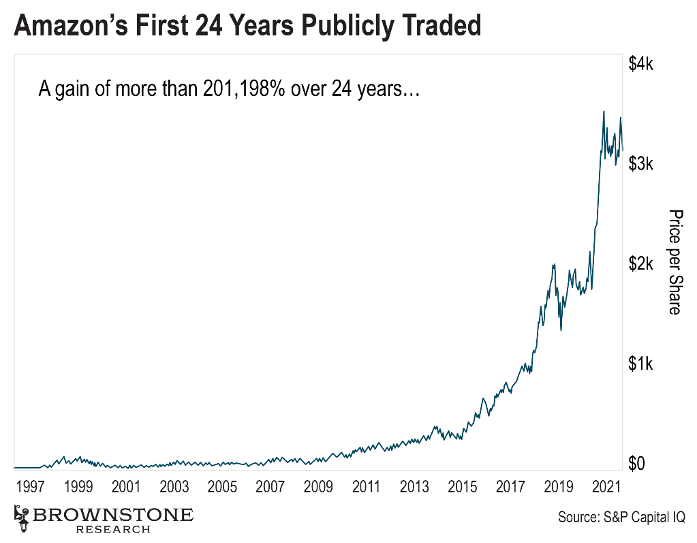
What’s more, any retail investor could have reaped huge gains from an early investment in Amazon.
It was a different era…
But a lot has changed since Amazon went public all those years ago.
Now we see many private companies going public at valuations that simply make no sense. And retail investors no longer have the chance to get in when the price is right. That’s certainly the story with some of the most infamous, recent initial public offerings (IPOs)…
— RECOMMENDED —
“Penny Trade” Pays Warren Buffett as Much as an Extraordinary 4,429%?

“Penny Trades” are cheap and explosive…
Warren Buffett grabbed 46 million of them for 1¢ a pop.
Right now, he’s up as much as a rare 4,429% on this trade.
But “Penny Trades” aren’t reserved for billionaires like Buffett.
Thanks to SEC loophole 30.52, you can play them in your brokerage account.
- One of these “Penny Trades” shot up 183% in one day…
- Penny Trades can pay far MORE than stocks…
- Our readers just saw a 19¢ trade shoot up as much as a rare 5,100%…
Here’s the No. 1 “Penny Trade” for RIGHT NOW
Jeff Brown’s Emergency Meeting #2: Avoid These Overvalued IPOs
Companies like Amazon used to go public BEFORE they experienced massive growth.
But today’s companies are no longer doing that…
They’re choosing to stay private longer — and only going public when they’re much larger.
And if we look at the current landscape for IPOs, we’ll see that most companies going public now would guarantee considerable losses.
Simply put, their earliest stages of growth have already passed. Retail investors can only pick up the scraps.
See for yourself.
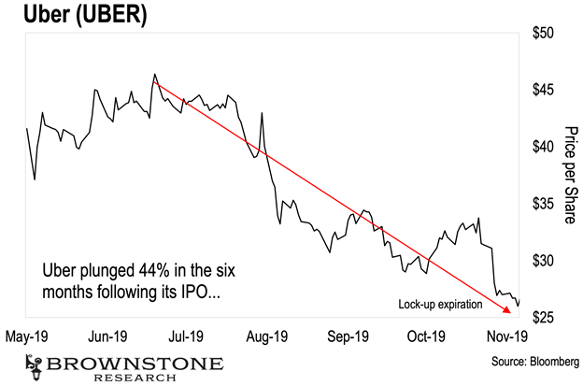
Uber was the premiere IPO of 2019. It went public with an enterprise value of around $75 billion. To put it in context, it was 171 times larger than Amazon was when it IPO’d.
And guess what — practically all of the gains went to private investors.
There are famous stories of some early investors turning $25,000 into $124 million… $50,000 into $248 million… or even $220,000 into a whopping $1 billion.
Meanwhile, retail investors who climbed in after the IPO would have realized gains of about 33%. That’s enough to turn every $1 invested into $1.33.
And then the stock plunged about 44% in the six months following its IPO. Anyone who invested around its IPO would have gotten burned.
Or take the data management software company, Snowflake. Last year, it held its own highly anticipated IPO at a sky-high valuation of more than $105 billion. It ended up being the largest software IPO to date.
But smart investors could see that Snowflake was nothing like Amazon in its earliest days. Snowflake has been around since 2012, building up its valuation in private capital.
By the time it went public last year, shares had begun trading at more than $240. And since its IPO, Snowflake’s sky-high valuation has dipped from over $105 billion to about $51 billion today — a fall of more than 40% from its pre-IPO highs.
I could go on…
I bring up all these examples to illustrate one simple truth — investing in these overhyped IPOs would’ve meant losing your shirt.
Wall Street overhyped these stocks — and retail investors paid the price for it.
Clearly, these stocks won’t bring much value to investors with an eye toward promising early stage companies. The typical IPO process has steadily morphed into an albatross that retail investors would do well to avoid…
But not in every case.
— RECOMMENDED —
Leading research firm that called peak of the Dot-Com boom issues next major warning:

Why popular tech stocks could be in store for a 92% meltdown – and the investment billionaires are turning to now…
Jeff Brown’s Emergency Meeting #2 Details
To help subscribers, Jeff Brown prepared an Emergency Meeting where he will share all the details. It’s all happening Wednesday, May 26, at 8 p.m. ET. It’s FREE to attend. You can claim your spot here.