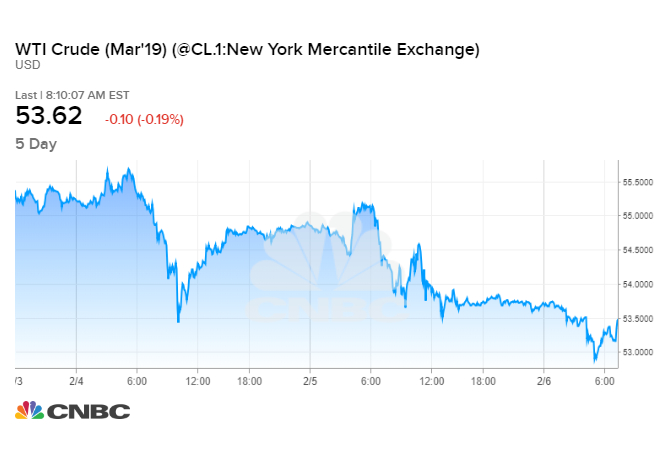
Oil prices mostly held earlier losses on Wednesday after weekly government data showed a rise in U.S. crude stockpiles.
Crude futures fell earlier after an industry report suggested a larger rise in crude inventories, while concerns about the impact on global supplies of U.S. sanctions on Venezuela faded.
Benchmark Brent crude slipped 21 cents to $61.77 a barrel around 10:30 a.m. ET (1530 GMT), after rallying about 15 percent in January. U.S. crude was down 39 cents at $53.27.
U.S. crude inventories rose by 1.3 million barrels last week, according to the U.S. Energy Information Administration. That compared to the 2.5 million-barrel increase reported by industry group the American Petroleum Institute on Tuesday afternoon.
“The fact that U.S. crude oil and gasoline stocks rose more sharply than expected, as reported by the API after close of trading yesterday, is weighing on prices,” said Carsten Fritsch, analyst at Commerzbank.
The U.S. announced sanctions on Venezuela’s state oil company last week, a move which could further curb supplies, although the development has yet to result in steep price gains.
“It would seem that the market is really not too worried yet about the potential loss of Venezuelan barrels,” said analysts at JBC Energy in a report.
“This is either because the market assumes that the size of the impact will not be large, or at least it will be of short enough duration,” they wrote.
Worries about weaker global economic growth and the trade dispute between the United States and China have also weighed on the market. Oil fell on Tuesday after a survey showed euro zone business expansion nearly stalled in January.
In his State of the Union address, U.S. President Donald Trump said a trade deal was possible with China. Senior U.S. and Chinese officials are poised to start another round of trade talks next week.
Supply cuts by the Organization of the Petroleum Exporting Countries and its allies, including Russia, have been supporting prices. Venezuela, an OPEC member, is like Iran and Libya exempt from making voluntary curbs under the deal.
The producers known as OPEC+ began cutting production from last month to avert a new supply glut and OPEC has delivered almost three-quarters of its pledged cutback already, according to a Reuters survey.
Fritsch of Commerzbank said the Venezuelan issue could still drive oil higher.
“The price has yet to react in any noticeable way,” he said. “That said, if the other OPEC countries fail to offset this outage, the oil market could quickly become undersupplied, driving the price up.”
— RECOMMENDED —
MENSA considers him a genius!
Find out how this former landscaper makes millions trading the trickiest market

Source: cnbc.com | Original Link